How to Get Cited in Google AI Overviews: 2026 Optimization Guide
Why traditional page-one rankings no longer guarantee search visibility, and how Google selects source citations for synthesized AI answers.
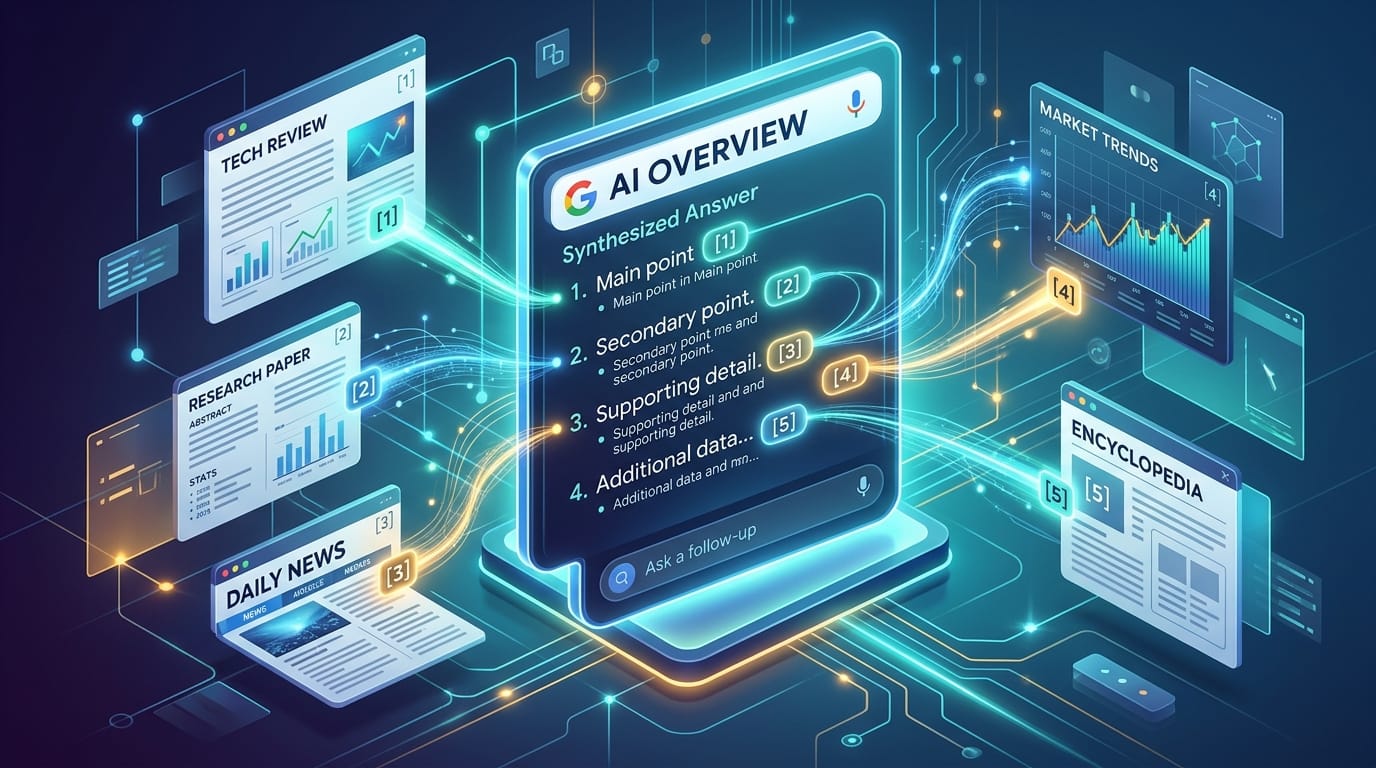
If you search for almost any commercial, informational, or comparison query on Google in 2026, the traditional list of ten blue links is no longer the first thing you see. Sitting above the organic search results is Google's AI Overview: a synthesized, multi-paragraph answer generated in real time by Gemini, complete with bulleted takeaways and interactive citation cards.
For business owners and marketing directors, this interface shift represents the biggest change in search behaviour in two decades. Even if your website holds rank two or three in the traditional organic listings, the AI Overview pushes your listing below the digital fold. If your brand is not one of the interactive citation pills attached to that generated summary, high-intent prospective clients will complete their research and make buying decisions without ever clicking through to your domain.
However, there is a major commercial opportunity that most competitors have not noticed: you do not need to hold position one on Google to earn an AI Overview citation. In fact, independent search studies reveal that more than 60 percent of source links in Google AI Overviews come from pages outside the top three organic results. What matters is not legacy backlink brute force, but how cleanly your content can be parsed and verified by Google's answer engine.
How Google AI Overviews Actually Selects Sources
To earn citations consistently, you must understand the underlying mechanics of how Google constructs an AI Overview. Google does not simply pass the entire web to a large language model. Instead, it uses a multi-stage retrieval and synthesis pipeline:
- 1. Query Classification & Triggering: Google evaluates whether the query benefits from synthesis. Complex multi-part questions, 'how-to' research, pricing comparisons, and diagnostic queries trigger AI Overviews, while navigational queries ('BBC login') do not.
- 2. Passage Retrieval (RAG): Rather than evaluating entire 3,000-word articles as single documents, Google's Passage Ranking algorithms identify granular blocks of text (typically 40 to 100 words) across indexed websites that directly answer individual aspects of the query.
- 3. Entity Disambiguation & Fact Verification: Google cross-checks extracted statements against its Knowledge Graph. If your content makes a specific commercial claim ('our audit takes 48 hours and covers 10 checks'), Google verifies whether your entity is recognized as a legitimate specialist in that field.
- 4. Synthesis & Attribution: Gemini generates a structured summary and links directly to the specific URLs that provided the supporting evidence, creating the interactive citation carousel.
The 5 Core Ranking Factors for AI Overview Citations
Based on patent analysis, algorithm updates, and live search observations across thousands of commercial queries, five architectural factors determine whether Google cites your website:
- 1. Answer-First Passage Architecture: Traditional SEO articles often bury the answer beneath 500 words of fluffy introductory narrative ('In today's fast-paced corporate world...'). AI Overviews actively filter out fluff. To get cited, place a direct, factual 40-to-70-word answer immediately beneath each H2 or H3 question header. Give the answer first, then provide the detailed explanation.
- 2. High Information Gain (Unique Data & Insights): Google holds a patent specifically on 'Information Gain Scores'. If your article merely paraphrases what twenty other blogs already say, Google's algorithm identifies zero unique value and ignores your page. AI Overviews favour sources that contribute net-new information: proprietary pricing data, original case study benchmarks, step-by-step checklists, or clear diagnostic frameworks.
- 3. Semantic Heading Hierarchy & Question Matching: Structure your content around plain, conversational customer language. Headings like 'How Much Does an AI Visibility Audit Cost in the UK?' earn citations exponentially faster than clever or abstract marketing headlines like 'Unlocking Tomorrow's Valuation Matrix'. Use logical H2 to H3 hierarchy without skipping heading levels.
- 4. Connected Schema.org Entity Graphs: AI search engines rely heavily on machine-readable JSON-LD schema to verify context. When your site explicitly links its Organization, LocalBusiness, Service OfferCatalog, and Founder Person schemas with persistent @id identifiers, you eliminate ambiguity and make it effortless for Gemini to cite your business as a trusted authority.
- 5. Sub-100ms Server Latency & Clean Semantic HTML: Google's real-time retrieval pipeline operates under strict computational time budgets. If your website takes 1.5 seconds to respond due to bloated databases or relies on heavy client-side JavaScript hydration to render text, Google will bypass your content in favour of a fast, edge-cached static website.
The 3 Traps That Disqualify Your Site from AI Overviews
Even high-ranking websites frequently fail to earn citations because of three common technical pitfalls:
- Trap 1: Text Trapped in Client-Side JavaScript: If your website is built on a heavy single-page application (SPA) where content renders only after scripts execute in the browser, search crawlers running in low-resource retrieval passes may see an empty container. Always ensure your primary content is fully pre-rendered in semantic HTML.
- Trap 2: Accidental Bot Restrictions in robots.txt: In an attempt to prevent AI models from training on their data, some site administrators add broad disallow rules blocking Googlebot, Google-Extended, or User-Agent headers. While blocking Google-Extended prevents Gemini training, blocking primary crawlers removes you from search indexing entirely. Review your directives carefully.
- Trap 3: Wall-of-Text Formatting Without Visual Scannability: Gemini excels at extracting information from HTML tables, numbered lists, and concise bullet points. Pages that present comparison data or pricing tiers inside unbroken prose paragraphs are far less likely to be parsed as authoritative sources.
Step-by-Step: How to Optimize an Existing Article for AI Overviews
If you already have articles or service pages ranking on page two or page three of Google, you can often earn an AI Overview citation in a matter of days by restructuring them:
- Step 1: Check the SERP for an Existing AI Overview: Search your target commercial query on Google. Does an AI Overview appear? If so, note which questions it answers, how many source cards are displayed, and which competitors are currently cited.
- Step 2: Add Dedicated H2 Target Sections: Create exact-match question headers that mirror the sub-topics inside the AI Overview. Common winners include definition headers ('What Is...'), pricing headers ('How Much Does... Cost?'), and methodology headers ('Step-by-Step Checklist').
- Step 3: Insert the Answer-First Block: Write a crisp, authoritative summary in 2 to 3 sentences immediately under the heading. Avoid jargon and state the key numbers or facts directly.
- Step 4: Add Structured Comparison Elements: Whenever comparing options or detailing costs, use clean HTML tables or bulleted lists. These provide Google's parsers with high-density data ready for direct extraction.
- Step 5: Verify Structured Data and Re-Inspect in Search Console: Ensure your JSON-LD schema validates cleanly with zero errors, then submit the updated URL via the Google Search Console URL Inspection tool to prompt a fresh crawl.
How AI Overviews Fit into a Modern GEO Strategy
Optimizing for Google AI Overviews is not an isolated tactic. It is one component of a broader Generative Engine Optimization (GEO) framework. The same architectural discipline that earns you a citation in Google also drives recommendations across ChatGPT Search, Perplexity Pro, and Claude.
To assess your website's current readiness for modern search engines, run our free site audit tool. In about a minute, it evaluates your server latency, mobile Core Web Vitals, and machine-readable structured data.
To explore our full engineering methodology for AI search visibility, discover our dedicated Generative Engine Optimization (GEO) services, or read our comprehensive guides on what an AI visibility audit includes, how to get cited by AI search engines across Perplexity and ChatGPT, and where AI finds its sources across the wider web ecosystem.